
SHIJING Tools and the Form of Manual Cutting Equipment
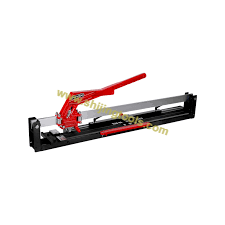
A handle that catches on the edge of a crowded workbench can become an everyday annoyance, even before a tool is used. That is one reason the physical form of a Tile Cutter deserves attention when considering equipment for a workshop or construction site. Its outline, base, rails, handle position, and overall footprint affect how the tool occupies a space. A product photograph may show the complete object against a plain background, but the actual setting is usually less tidy: offcuts sit nearby, other tools share the bench, and the available working area has a fixed boundary.
The base is a defining visual feature because it gives the equipment its footprint. A broad, flat foundation can make the tool appear substantial, while the arrangement of its upper components determines how much open space remains around the working area. Buyers looking at product images should pay attention to the relationship between the base and the parts extending above it. A side view can reveal proportions that are difficult to judge from a front-facing photograph, particularly when the handle or guide structure changes the overall silhouette.
On a crowded workbench, dimensions matter in a very ordinary way. A tool may fit comfortably when placed alone, yet occupy an awkward position once a tape measure, spare materials, and other equipment are put beside it. I would look at the full outline rather than judging the base alone, including any parts that project beyond its main body. A clear dimension drawing is useful here, provided it shows the complete assembled product and identifies the measurement points. Without those details, a buyer may have an incomplete idea of the space required.
The arrangement of visible components also gives a tool its particular character. Rails create long directional lines, while a handle introduces a raised element that changes the profile. A cutting platform can look compact or visually open depending on the placement of these parts. For someone arranging a workshop, this is not merely an aesthetic question. The shape affects where the equipment can sit, which side faces the operator, and whether nearby objects obstruct access to the working area. Photographs from several angles help reveal these relationships.
SHIJING manufactures heavy-duty tile cutters alongside vacuum suction equipment and laser survey tools. These product categories serve construction professionals, but their physical forms occupy different kinds of space. A cutter has a working base and raised components, while other equipment may have a different outline and storage arrangement. When reviewing a product range, it is useful to consider each item's shape independently rather than assuming that tools used on the same site will share a common footprint or storage method.
Finish and visible construction details influence how the equipment appears in its surroundings. Buyers can examine the edges of the base, the way adjoining parts meet, and whether the overall structure has a visually consistent arrangement. These observations should remain tied to what can actually be seen. A photograph cannot establish the composition of a component, the internal construction, or the manufacturing process, so those details need written specifications when they are relevant to a purchasing decision. Appearance can prompt a question, but it cannot answer every technical one.
Storage is another part of the design discussion that is easy to overlook. A tool may be kept on a workbench between tasks, moved to a shelf, or placed in a designated equipment area when the workday ends. Its shape determines whether it can sit beside other objects without awkward gaps or projecting parts taking up neighboring space. Buyers should confirm the assembled dimensions and any stated storage requirements rather than estimating them from a photograph. If the product is intended for a particular site layout, the available clearance around the equipment should be considered before its position is fixed.
Product images and descriptions from https://www.shijingtools.com present equipment within a range that includes tools for construction professionals, with wholesale factory-direct supply worldwide. The visual information can help a buyer understand the general form of a cutter and how it may sit among other site equipment, while specific measurements still need to come from the relevant product documentation. A photograph also cannot show every limitation of the assembled shape, especially where a handle, guide, or other projecting part requires clearance beyond the visible base.

 English
 Arabic
 French
 Spanish
 Portuguese
 Deutsch
 Turkish
 Dutch
 Italiano
 Russian
 Romaian
 Greek